
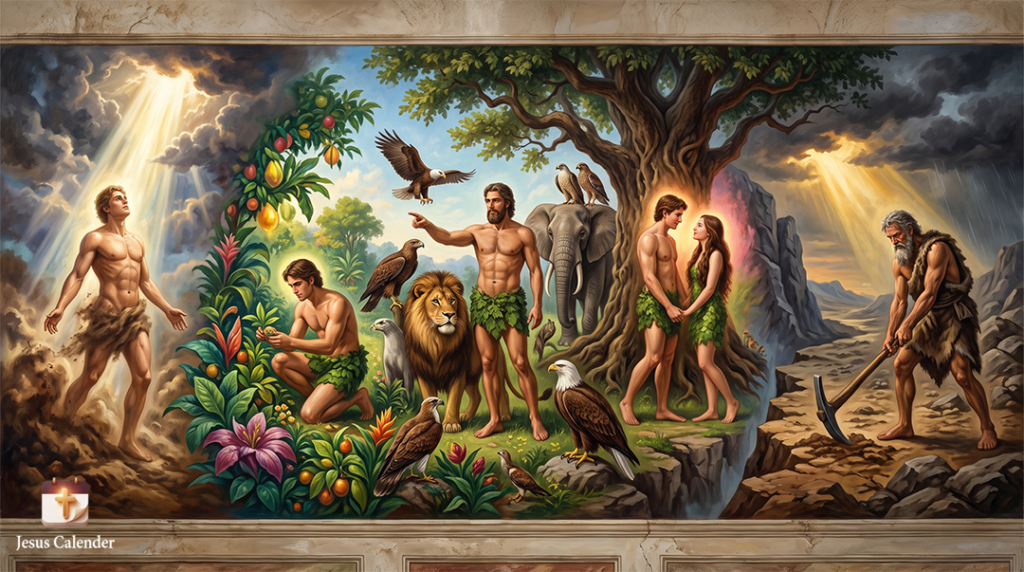
The Dawn of Humanity: Adam’s Foundational Deeds
The biblical narrative of Adam presents a unique kind of heroism. Unlike later figures such as Moses, David, or Esther, Adam did not lead armies, conquer lands, or overthrow empires. Instead, his “mighty deeds” were the very first acts of human existence. As the prototype of humanity, his historical and spiritual significance lies in his foundational experiences of life, intellect, stewardship, and survival. Every action he took was a direct result of being formed by the Creator and animated by divine breath.
To understand Adam’s journey is to observe humanity in its absolute origin, transitioning from perfect communion with God to the painful reality of a fallen world, yet surviving through God’s enduring grace.
| Phase of Life | Foundational Deed | Divine Assistance |
| Awakening | Rising from the dust into consciousness | Receiving the direct breath of God |
| Stewardship | Tending and cultivating the Garden of Eden | Guided by God’s perfect ecological design |
| Dominion | Naming all living creatures | Endowed with divine intellect and authority |
| Union | Establishing the first marriage | Receiving a partner formed by God’s hand |
| Resilience | Surviving the harsh earth after the Fall | Clothed and sustained by God’s mercy |
Through God’s design and continued grace, Adam’s life was defined by five pivotal events that set the course for all of human history.
I. The Awakening from Dust
Adam’s very existence was his first miraculous experience. Unlike the rest of creation, which was spoken into existence, the biblical text describes God intimately forming man from the dust of the ground. God then breathed the “breath of life” into his nostrils, and Adam became a living soul. This awakening was a mighty deed of creation—a transition from lifeless clay to a conscious, feeling, and thinking being, made in the image and likeness of God. His first waking moment was a profound, unmediated encounter with his Creator.
II. The Stewardship of Eden
God did not place Adam in the Garden of Eden to be idle. He was given a divine commission: to work it and take care of it. This was the first mighty deed of human labor and responsibility. With God’s help, Adam cultivated a pristine, harmonious world. There were no weeds, no decay, and no resistance from the earth. His work was a pure act of worship, demonstrating that humanity was originally designed to partner with God in maintaining and nurturing creation.
III. Exercising Dominion: Naming the Animals
One of the most remarkable demonstrations of Adam’s God-given intellect was the naming of the animals. God brought every beast of the field and bird of the air to Adam to see what he would name them. This was an immense cognitive and authoritative feat. Adam did not just assign random sounds; in the ancient context, naming something implied understanding its nature and exercising stewardship over it. With a mind unclouded by sin and perfectly aligned with God’s wisdom, Adam categorized and defined the biological world around him.
IV. The First Union
Despite his perfect environment and direct relationship with God, Adam experienced the first human need: companionship. God recognized that it was not good for man to be alone. Causing Adam to fall into a deep sleep, God took one of his ribs and formed a woman, Eve. When Adam awoke and saw her, he performed a mighty deed of poetic recognition, declaring, “This is now bone of my bones and flesh of my flesh.” This event established the first human relationship, the foundation of community, and the sanctity of marriage, all orchestrated entirely by divine grace.
V. Resilience Beyond the Garden
The most tragic chapter of Adam’s life was the Fall—the choice to eat from the tree of the knowledge of good and evil, which fractured his relationship with God. Exiled from Eden into a harsh, unforgiving wilderness, Adam faced a world of thorns, sweat, and impending physical death. Yet, his final “mighty deed” was one of survival and faith. With God’s merciful provision of garments made from animal skins, Adam and Eve forged a life in the wilderness. He became the father of humanity, clinging to God’s promise that a future seed would eventually crush the serpent and redeem their catastrophic mistake.